
Project MMP
Multimodal Behaviour Trees for Robotic Laboratory Task Automation
1Department of Chemistry and Materials Innovation Factory, University of Liverpool, Liverpool, United Kingdom; 2Department of Computer Science, University of Liverpool, Liverpool, United Kingdom;
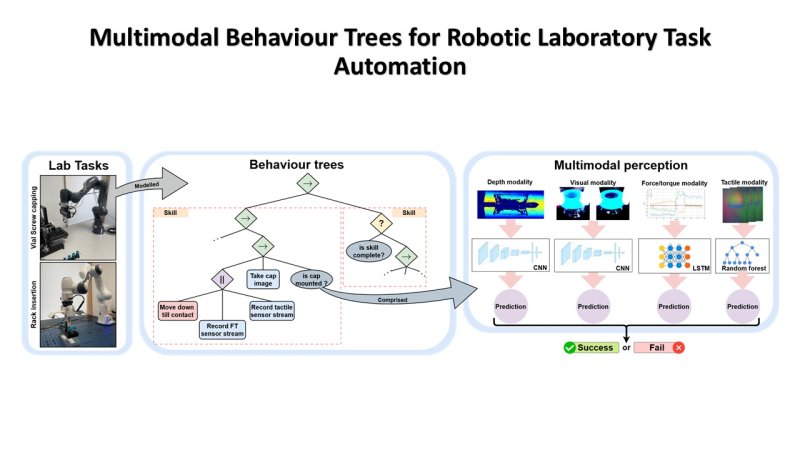
Laboratory robotics offer the capability to conduct experiments with a high degree of precision and reproducibility, with the potential to transform scientific research. Trivial and repeatable tasks; e.g., sample transportation for analysis and vial capping are well-suited for robots; if done successfully and reliably, chemists could contribute their efforts towards more critical research activities. Currently, robots can perform these tasks faster than chemists, but how reliable are they? Improper capping could result in human exposure to toxic chemicals which could be fatal. To ensure that robots perform these tasks as accurately as humans, sensory feedback is required to assess the progress of task execution. To address this, we propose a novel methodology based on behaviour trees with multimodal perception. Along with automating robotic tasks, this methodology also verifies the successful execution of the task, a fundamental requirement in safety-critical environments. The experimental evaluation was conducted on two lab tasks: sample vial capping and laboratory rack insertion. The results show high success rate, i.e., 88% for capping and 92% for insertion, along with strong error detection capabilities. when compared to individual model predictions. This ultimately proves the robustness and reliability of our approach and that using multimodal behaviour trees should pave the way towards the next generation of robotic chemists.
Click here for full paper.
Graphical Abstract
Video Demonstration
