
Project PREVENT
PREVENT: Proactive Risk Evaluation and Vigilant Execution of Navigation and Manipulation Tasks for Mobile Robotic Chemists
1Department of Chemistry and Materials Innovation Factory, University of Liverpool, Liverpool, United Kingdom; 2Center for Life Science Automation (CELISCA), University of Rostock, Rostock, Germany
Mobile robotic chemists are a fast growing trend in the field of chemistry and materials research. However, so far these mobile robots lack workflow awareness skills. This poses the risk that even a small anomaly, such as an improperly capped sample vial could disrupt the entire workflow. This wastes time, and resources, and could pose risks to human researchers, such as exposure to toxic materials. Unimodal perception mechanisms can be used to predict anomalies but they often generate excessive false positives. This may halt workflow execution unnecessarily, requiring researchers to intervene and to resume the workflow when no problem actually exists, negating the benefits of autonomous operation. To address this problem, we propose navigation and manipulation skills based on a multimodal Behavior Tree (BT) approach that can be integrated into existing software architectures with minimal modifications. Our approach involves a hierarchical perception mechanism that exploits AI techniques (CNNs and VLMs) and sensory feedback through Dexterous Vision and Navigational Vision cameras and an IoT gas sensor module for execution-related decision-making. Experimental evaluations show that the proposed approach is comparatively efficient and completely avoids both false negatives and false positives when tested in simulated risk scenarios within our robotic chemistry workflow. The results also show that the proposed multi-modal perception skills achieved deployment accuracies that were higher than the average of the corresponding uni-modal skills, both for navigation and for manipulation.
Graphical Abstract
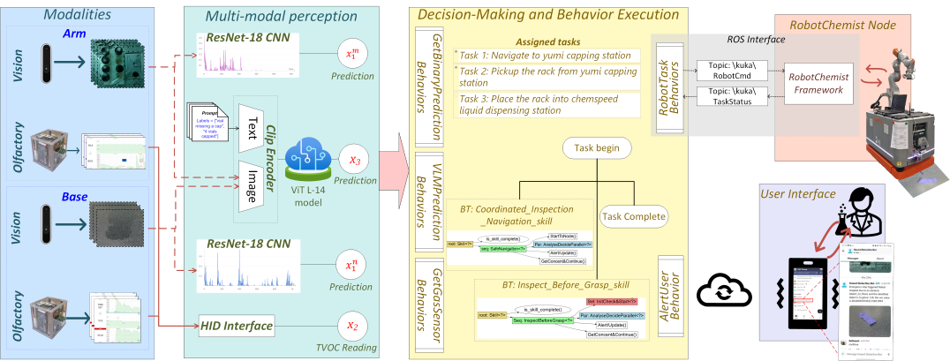
Figure: Coordinated Inspection and Navigation (CIN) Skill

Video Demonstration - CIN 1
Video Demonstration - CIN 2
